Nanofuture: What's Next For Nanotechnology by J. Storrs Hall Ph.D
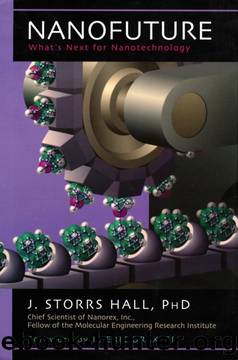
Author:J. Storrs Hall Ph.D.
Language: eng
Format: epub
Published: 2013-04-29T23:20:00+00:00
t was 1969, the year of Apollo 11 and Woodstock. The tumultuous 1960s had just seen a countercultural revolution and a widespread disaffection with science and technology, especially on university campuses where government-sponsored research was associated with the Vietnam War. At Princeton, physics professor Gerard O'Neill, inventor of the particle storage ring, had drawn the rotating duty of the freshman physics course and was looking for some way to make it socially relevant.
That was also the year that the San Francisco city council adopted the Earth Day holiday, which was then celebrated on the vernal equinox in 1970. In other words, environmentalism was becoming relevant. So O'Neill put all this together and challenged his students: "Is a planetary surface the right place for an expanding technological civilization?" And if not, the unstated subtext implied, what was?
O'Neill and a small cadre of interested students got to work, and over the course of the next few years, an interesting and somewhat unexpected answer began to emerge. In science fiction, the consensus view that had developed into an orthodoxy over the first part of the century had assumed that we would eventually settle onto the surfaces of other planets. But O'Neill's group started out, perhaps by the accident of the wording of the challenge, with a different perspective. They found an alternative: build living places in space, from scratch. And the more they looked at it, the more the numbers seemed to work out.
As the 1960s turned into the mid-1970s, the idea had caught on and the designs took on significant detail. The Club of Rome's Limits to Growth' had come out; the energy crisis was in full cry; environmental concern was increasing; the Earth's population seemed ready to burst the seams of this small, overburdened planet.
"O'Neill colonies," as they came to be called, would be miniature, inside-out worlds. They would rotate to provide gravity, and since the ground would be on the outside, it would serve as a radiation shield in the place of Earth's miles-thick atmosphere. Plans and artists' conceptions called for lush garden communities; lots of plants would help recycle the air. Farming and industry would flourish nearby in separate structures.
In space you can set out mirrors thinner than household aluminum foil, and they'll just stay where you put them, with no wind or weather and the completely predictable microgravity of orbit.2 Such mirrors collect a completely clean, uninterrupted, totally reliable solar power. For example, a burner on your stove in the space habitat could be powered by mirroring in sunlight from just a couple of square yards outside. No coal mining, no atmospheric effluents, no nuclear power plants, no cross-country power grid; just a collector the size of a golf umbrella.
The material to build the habitats would come mostly from the Moon, whence it was an order of magnitude easier to get into the orbits of interest than material from the Earth. Lunar soil was being analyzed by the follow-up Apollo missions and found to contain almost all the necessary elements-only hydrogen would have to come from Earth.
Download
This site does not store any files on its server. We only index and link to content provided by other sites. Please contact the content providers to delete copyright contents if any and email us, we'll remove relevant links or contents immediately.
Sapiens: A Brief History of Humankind by Yuval Noah Harari(14553)
The Tidewater Tales by John Barth(12754)
Mastermind: How to Think Like Sherlock Holmes by Maria Konnikova(7549)
The Thirst by Nesbo Jo(7105)
Do No Harm Stories of Life, Death and Brain Surgery by Henry Marsh(7030)
Why We Sleep: Unlocking the Power of Sleep and Dreams by Matthew Walker(6856)
Life 3.0: Being Human in the Age of Artificial Intelligence by Tegmark Max(5687)
Sapiens by Yuval Noah Harari(5451)
The Body: A Guide for Occupants by Bill Bryson(5286)
The Longevity Diet by Valter Longo(5165)
The Rules Do Not Apply by Ariel Levy(5090)
The Immortal Life of Henrietta Lacks by Rebecca Skloot(4699)
Animal Frequency by Melissa Alvarez(4558)
Why We Sleep by Matthew Walker(4546)
The Hacking of the American Mind by Robert H. Lustig(4475)
Yoga Anatomy by Kaminoff Leslie(4453)
All Creatures Great and Small by James Herriot(4416)
Double Down (Diary of a Wimpy Kid Book 11) by Jeff Kinney(4408)
Embedded Programming with Modern C++ Cookbook by Igor Viarheichyk(4276)
